The Citation Myth: Why Buying 500 Citations Won't Fix Your Google Map Rankings
Written by Sakib Quraishe | Local SEO specialist, Chittagong, Bangladesh
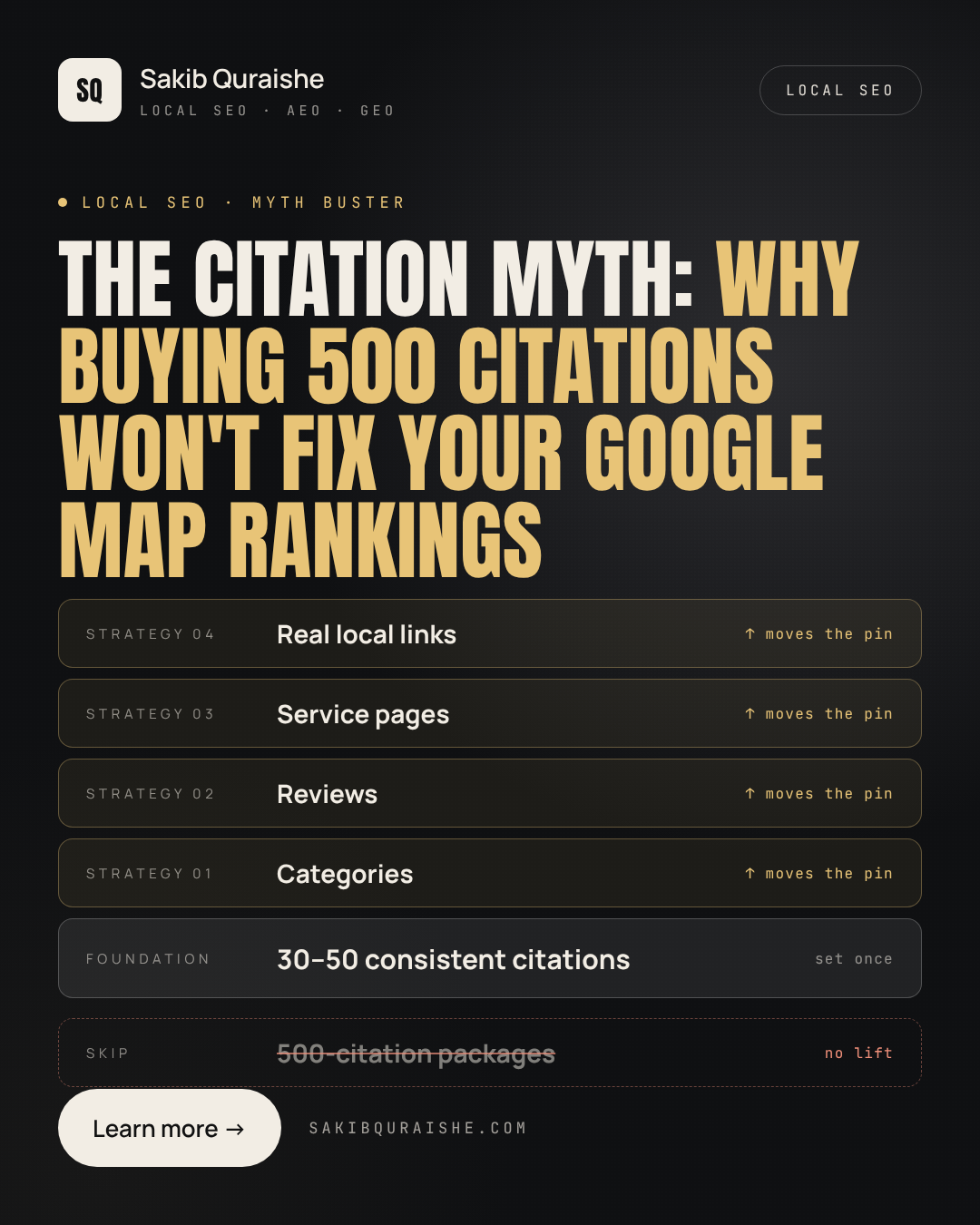
Buying 500 directory citations will not push a business to the top of Google Maps. Citations are a foundation, not a growth strategy. Around 30 to 50 accurate, consistent listings on the directories that matter is usually enough. After that, rankings move because of your Google Business Profile categories, reviews, service pages and genuine local links.
If you have paid for a big citation package and your map position barely changed, this post explains why, and where that budget should go instead.
What is a local citation?
A local citation is any online mention of a business's name, address and phone number, often called NAP. Citations appear on business directories like Yelp, Bing Places and Apple Business Connect, on industry sites, on local chamber of commerce pages and in news articles. They help search engines confirm that a business is real and that its details are correct.
There are two kinds. Structured citations are directory listings with fixed fields for name, address and phone. Unstructured citations are mentions in ordinary text, such as a local blog post or a newspaper story that names the business.
Why did citations matter so much in the past?
Ten years ago, Google had far fewer ways to check whether a local business was legitimate. Directory listings were one of the main signals available, so a business listed consistently on many directories looked more trustworthy than one that was not.
That is where the citation-volume industry came from. Agencies sold packages of 100, 300 or 500 listings, and for a while more listings often did mean better visibility.
Google's local systems have changed a great deal since then. They now draw on review content, behaviour signals like clicks and calls, website relevance, links, photos and the information inside the Google Business Profile itself. Citations still play a role, but they are one input among many, and their value levels off quickly.
Why don't 500 citations move your ranking?
There are four main reasons, and I see all of them in audits.
* Most of the 500 sites have no real authority. Many are low-quality directories that nobody visits and Google barely crawls.
* After the core directories are covered, each additional listing adds almost nothing new. Google already knows your name, address and phone.
* Bulk packages often create inconsistencies, such as old addresses, slightly different business names or tracking numbers that do not match your main phone.
* Citations do not fix the real problem. If a listing is stuck, it is usually because of weak categories, few reviews, thin service pages or a lack of local authority.
The third point is the most dangerous. A messy citation profile can actually hurt you, because conflicting details make Google less confident about which information is correct.
How many citations does a local business actually need?
For most service businesses, around 30 to 50 accurate citations is enough. That covers the major data sources, the main general directories, the leading sites for your industry and a handful of genuinely local sources such as your chamber of commerce or regional business associations.
Quality matters more than count. One listing on a respected industry directory that sends real customers is worth more than a hundred listings on sites nobody uses. When I work with clients across the USA and UK from my base in Chittagong, Bangladesh, the citation phase is usually a few weeks of clean-up and core listings, not a never-ending monthly package.
Which citations should you prioritise?
Start with the sources that feed the rest of the web and the ones customers actually use.
1. Google Business Profile, which is not technically a citation but is the foundation of everything else.
2. Bing Places, Apple Business Connect and the major data aggregators for your country.
3. General directories with real traffic, such as Yelp and the Better Business Bureau in the US, or Yell and Thomson Local in the UK.
4. Industry directories specific to your trade, such as home-services platforms for contractors or healthcare directories for clinics.
5. Local sources like your chamber of commerce, local business groups and community sites.
Bing Places deserves special attention now. ChatGPT's search features lean on Bing's index, so an accurate Bing listing helps both traditional search and AI-generated recommendations.
What should you fix before building any new citations?
Audit what already exists. Search for your business name, old addresses and old phone numbers, and list every place your business appears. Then correct or remove the listings with wrong details.
Pay particular attention to these problems:
* Old addresses from a previous office or a home address you no longer use.
* Different versions of your business name, such as "Smith Plumbing" on one site and "Smith Plumbing & Heating LLC" on another.
* Call-tracking numbers that appear instead of your main phone number.
* Duplicate listings for the same business on one directory.
Fixing ten wrong listings will usually do more for your rankings than adding a hundred new ones.
If not citations, what actually moves Google Maps rankings?
Once your core citations are clean, the signals that move the map are the ones that show relevance and prominence.
* Your primary category in Google Business Profile, which is one of the strongest relevance signals you control.
* Reviews, especially recent reviews that mention the specific service the customer used.
* Service pages on your website that clearly match what people search for.
* Real local links from sponsorships, partnerships, local news and community organisations.
* Engagement with your profile, such as calls, direction requests and website clicks.
These signals are harder to buy, which is exactly why they carry more weight. They reflect a real business doing real work in a real place.
Do citations matter for AI search and answer engines?
Yes, but in a different way. AI tools like ChatGPT, Perplexity and Google AI Overviews look for consensus. When many independent, trustworthy sources describe your business the same way, that description becomes something an AI system can confidently repeat.
That means consistency matters more than ever, but volume still does not. Ten authoritative sources that all describe your business accurately are far more useful to an AI system than 500 low-quality listings with mixed details. Industry roundups, review platforms and local news mentions tend to carry the most weight in AI answers.
How can you tell if a citation package is worth buying?
Ask the provider three questions before paying.
1. Which specific directories will you use, and how much real traffic do they get?
2. Will you audit and clean up my existing listings first?
3. Who owns the login details for each listing afterwards?
If the provider cannot name the directories, does not mention clean-up, or keeps control of the listings, walk away. A good citation service is a one-time foundation project with a clear list of sources, not a volume-based subscription.
What does a clean citation audit look like in practice?
A good audit ends with a simple spreadsheet. Each row is one listing, with the site name, the URL, the name, address and phone shown there, whether they match your official details, and the action needed. The official details sit at the top so every listing is checked against the same version.
Most audits I run for service businesses find a handful of listings with wrong details, a few duplicates and several important directories where the business is missing. Fixing that short list is a few days of focused work, and it usually does more than months of new listings would.
How do citations compare with the signals that actually move rankings?
It helps to see where citations sit next to the other things a local business can work on. This table compares them by how much they typically influence Google Maps rankings and how long they keep paying off.
Signal
Typical impact on map rankings
How long it keeps helping
Core citations (30 to 50, accurate)
Foundation; needed for trust
Long term, with occasional checks
Extra citations beyond the core
Very low
Little to none
Primary GBP category
High
Long term
Recent, detailed reviews
High
Ongoing, needs a steady flow
Service pages on your website
Medium to high
Long term
Real local links and mentions
Medium to high
Long term
The pattern is clear. Citations are worth getting right once, but the bigger, longer-lasting gains come from the signals that are harder to fake.
Frequently asked questions
Can bad citations hurt my Google Maps ranking?
They can. Inconsistent names, old addresses and wrong phone numbers make Google less certain about your details, which can weaken your visibility.
Should I delete old citations?
Correct them where you can. Remove duplicates and listings for closed locations, because outdated information confuses both customers and search engines.
Are citations still worth doing in 2026?
Yes, as a foundation. Accurate listings on the key directories help Google and AI tools trust your details. They just will not carry your rankings on their own.
How often should I check my citations?
Review them every six months, and immediately after any change to your address, phone number or business name.
Are citations still a ranking factor in 2026?
They still matter as a trust and consistency signal, but their influence is far smaller than it used to be. Accurate core citations help; large volumes add very little.
What is the difference between NAP and citations?
NAP is your business name, address and phone number. A citation is any place online where that NAP appears. Consistent NAP across citations helps search engines trust your details.
Do I need citations if I am a service-area business?
Yes, but list your business carefully. On directories that allow it, hide your address the same way you do on Google, and keep your name and phone consistent everywhere.
Is BrightLocal or Whitespark worth it for citations?
Both are well-known tools for auditing and building citations. They are most useful for finding and fixing inconsistent listings, not for buying hundreds of extra ones.
The bottom line
Citations are like the foundation of a house. You need one, it needs to be solid, and once it is built, pouring more concrete will not add another floor. Get your 30 to 50 core listings accurate and consistent, then spend your time and budget on categories, reviews, service pages and local links. That is what actually moves the pin.
About the author
Sakib Quraishe is a local SEO consultant in Chittagong, Bangladesh, who audits and cleans up citation profiles for service businesses in the USA, UK and Canada. He often finds that clients have paid for hundreds of directory listings when a short list of corrected core citations, plus better reviews and service pages, would have moved their map rankings further.

Comments
Post a Comment